
Meetings end.The work doesn't.
Taskbit joins your calls, captures who agreed to do what, and turns it into real tasks in the tracker your team already runs on — Jira, Asana, or GitHub — owner, deadline, and priority filled in, before anyone forgets the conversation happened.
Works with Google Meet · Zoom · Teams / Pushes to Jira · Asana · GitHub · Slack
 Google Meet
 Zoom
Zoom Microsoft TeamsDelivers to
 Jira
Jira Asana
Asana GitHub Projects
 SlackGoogle MeetZoomMicrosoft TeamsDelivers toJiraAsanaGitHub ProjectsSlack
Meeting notes are where decisions go to die.
Everyone nods, the call ends, and the action items live in someone’s memory or a doc nobody reopens. A week later the work hasn’t moved, the deadline is fuzzy, and no one is quite sure who owned it. The meeting happened. The follow-through didn’t.
- yazid follows up w/ design?
- someone sends the proposal
- fix the thing from last wk
- ??? deadline tbd
- ping client back (which one)
Four things happen on their own. You just show up.
- 01
It watches your calendar
Connect Google Calendar once. From then on, Taskbit joins the meetings that have a video link — you never schedule a bot by hand.
Google Calendar - 02
The bot joins and listens
It enters your Meet, Zoom, or Teams call as a visible participant — it shows up in the attendee list like anyone else — and transcribes the conversation speaker by speaker.
Visible · consent-friendly - 03
It pulls owners and deadlines
When the call ends, Taskbit finds every commitment, matches each one to the teammate who made it, and attaches a due date and a priority.
Summary · decisions · action items - 04
Tasks land where you work
Review the list, then push each item into the tracker your team already runs on — Jira, Asana, or GitHub — as a task with the owner, due date, and priority written in. A Monday digest chases whatever is still open.
Jira · Asana · GitHub · Slack
A sentence in the call becomes a ticket with an owner.
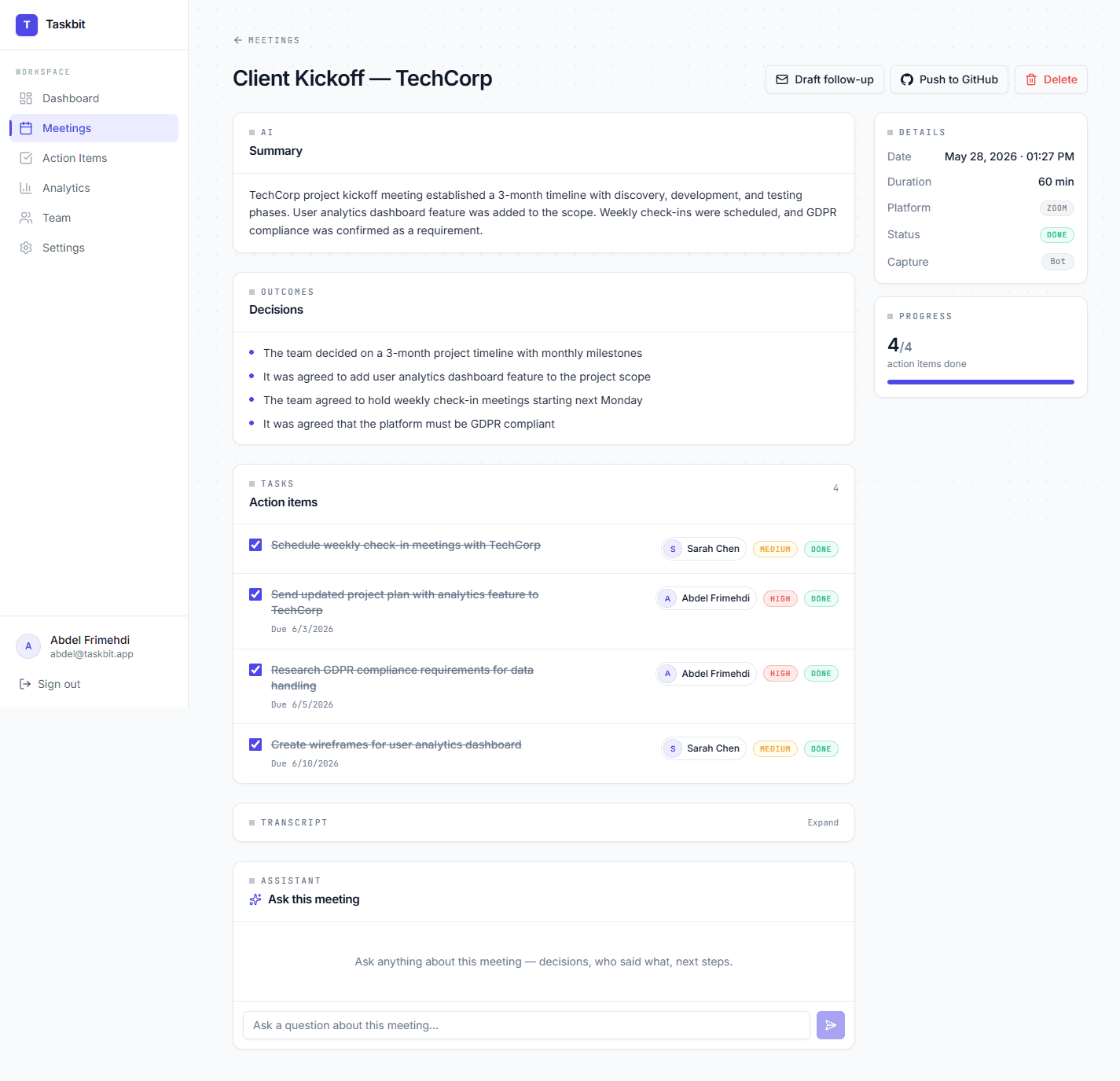
Nobody paused to take a note. Taskbit heard the commitment, gave it an owner and a deadline, and filed it in your tracker — while the meeting kept going.
Google MeetKarim, can you get the TechCorp proposal out before Friday?
Yeah — I’ll own that.
I’ll send the proposal Thursday, once Sofia signs off on pricing.
JiraListening to the call…
Nobody typed this. Taskbit did — mid-call.
Tasks in the tool you already run on.
Most notetakers dump a summary into a doc and call it done. Taskbit writes the commitment into your real backlog — a Jira, Asana, or GitHub task with the owner, the due date, and the priority already filled in. You review the list, then push it — nothing lands in your board without you.
Jira
LiveEvery action item becomes an issue in your Jira project — owner, due date, and priority mapped to your fields, ready for your board.
Asana
LiveEvery action item becomes a task in your Asana project — owner and due date filled in, ready for your board.
GitHub Projects
LiveEvery action item becomes a labeled issue on your board — owner, due date, and priority written in.
Slack
LiveMeeting recaps post to your channel, and overdue items get DMed straight to whoever owns them.
It's not a transcript. It's who owes what, by when.
Owned, dated, in your backlog
Open · 3Every commitment becomes a tracked task — a person, a deadline, a priority. Push it to Jira, Asana, or GitHub and it carries all three across, so the backlog reflects the meeting instead of someone’s memory of it.
A summary tells you what happened. Taskbit moves the work.
The team agreed Karim will send the proposal to TechCorp by Monday, review the pricing before that, and schedule the design review. Follow-up was left to whoever remembers.
- ✕You re-read a summary to remember what was agreed
- ✕You turn the discussion into tasks by hand
- ✕Nobody clearly owns anything
- ✕Deadlines live in someone’s head
- ✕Follow-up happens only if someone remembers
A flat summary. You still turn it into work.
For teams that are tired of chasing their own meetings.
Agencies & client services
Every client call becomes owned tasks in Asana or Jira — who owes what, by when — so nothing billable slips between the meeting and the invoice.
AsanaJiraProduct & engineering teams
Standups and planning turn into Jira or GitHub issues with owners and priorities — nobody re-types the sprint board after the call.
JiraGitHubDistributed & multilingual teams
Across time zones and languages, “wait, who was doing that?” becomes owned tasks in your tracker and a digest that keeps async work honest.
SlackMon digestOne flat price per workspace. Not per seat.
Start free and feel the full loop — recording, transcript, notes, tasks in your tracker. Upgrade when your team needs more meetings.
Starter
$0forever
The complete product, sized for trying it properly.
- ✓5 meetings per month, shared across your workspace
- ✓Up to 3 workspace members
- ✓AI summaries, meeting notes, decisions and action items
- ✓Push tasks to Jira, Asana, GitHub and Slack
Pro
For teams$19per workspace / month
Everything unlimited where it counts.
- ✓Unlimited meetings every month
- ✓Up to 10 workspace members
- ✓Everything in Starter — nothing is feature-gated
- ✓One subscription covers the whole team
Prices exclude tax. Cancel anytime from the billing portal — your data stays.
The questions worth asking first.
Stop being the reason things get remembered.
Connect your calendar, point Taskbit at your tracker — Jira, Asana, or GitHub — and let your next meeting file its own follow-ups. Free to start, no card.
No credit card · 2-minute setup · Cancel anytime
- Send the proposal to TechCorpJira
- Review the proposal pricingAsana
- Schedule the design reviewGitHub